The Law Has Changed. Strategy Wins.
Why the New Tax Environment Is Creating a Major Shift Toward SMSFs and Strategic Wealth Planning
Australia’s tax and investment landscape is changing rapidly.
For years, many Australians relied on familiar wealth-building strategies such as negative gearing, discretionary trusts and long-term property investing under stable Capital Gains Tax (CGT) settings.
But the environment is evolving — and strategic planning is becoming more important than ever.
The reality is simple: Those who adapt early may place themselves in a significantly stronger financial position over the next decade.
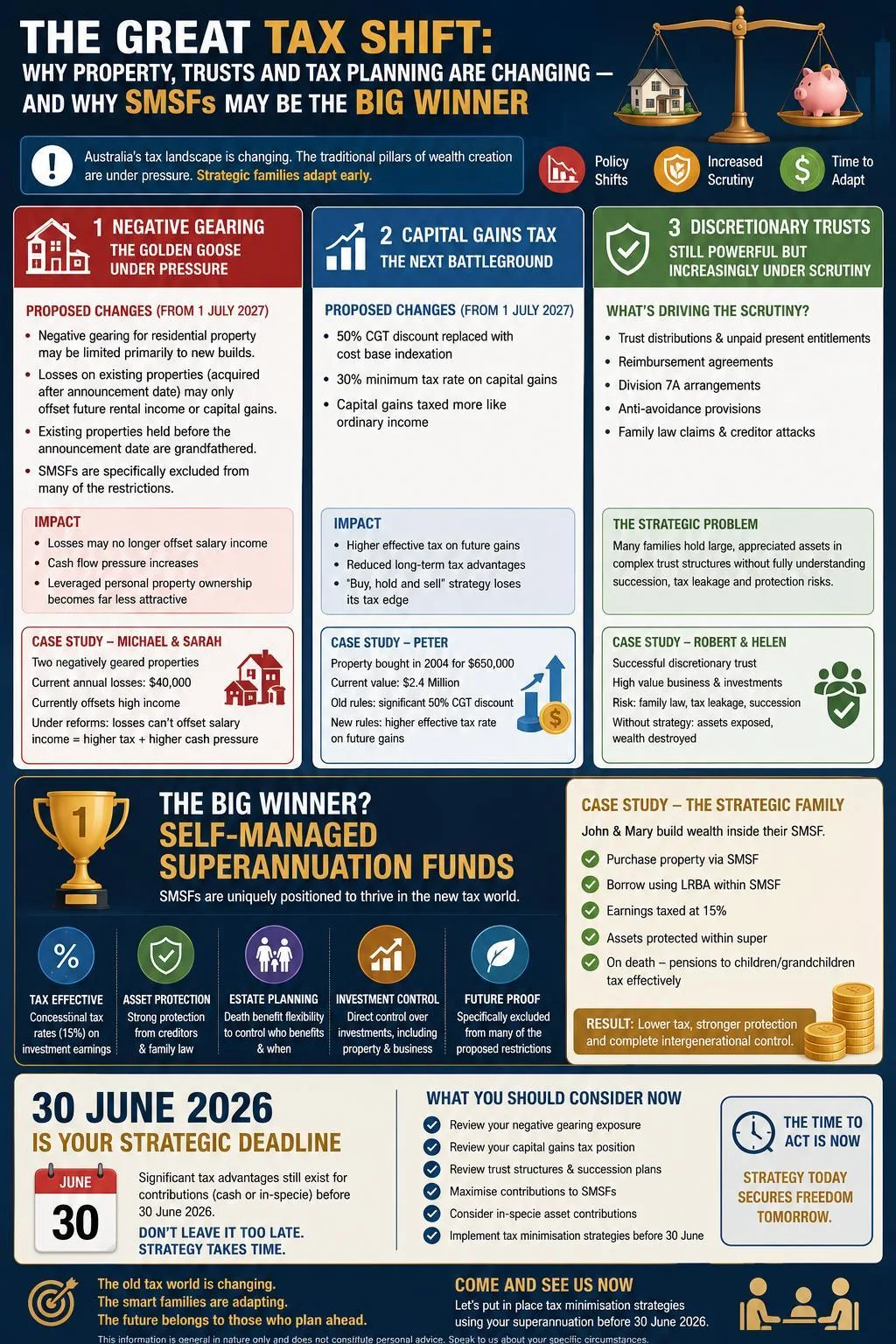
The Four Big Areas Under Pressure
1. Negative Gearing
Negative gearing has long been one of the cornerstones of Australian property investing. Investors have traditionally been able to offset rental property losses against other taxable income.
However, governments and policymakers continue to examine ways to restrict or reduce these benefits — particularly for higher income earners.
For many investors, this means:
- Reduced tax effectiveness
- Lower cash flow support
- Greater emphasis on property quality and growth
- A need for more sophisticated ownership structures
The days of relying solely on tax deductions to make an investment work may be fading.
2. Capital Gains Tax (CGT)
Capital Gains Tax remains one of the most important wealth considerations for investors.
Current rules allow many individuals and trusts to access a 50% CGT discount on assets held longer than 12 months. But proposed and flagged changes continue to raise concerns about:
Reduced CGT concessions
Increased taxation on investment profits
Higher effective tax rates on disposals
More importance on timing and structuring
For investors with large unrealised gains, strategic planning around asset ownership and future exits is becoming critical.
3. Discretionary Trusts
Despite ongoing scrutiny, discretionary trusts remain one of the most powerful wealth protection and tax planning tools available.
They continue to provide:
- Asset protection benefits
- Income distribution flexibility
- Intergenerational wealth planning
- Tax management opportunities
However, the compliance burden is increasing.
Areas such as:
- Division 7A
- Beneficiary reporting
- ATO scrutiny
- Documentation and governance
…are becoming far more important than they were a decade ago.
Trusts are not “dead” — but they are becoming more sophisticated vehicles that require proper strategy and management.
The Big Winner: SMSFs
As tax rules tighten elsewhere, Self-Managed Superannuation Funds (SMSFs) are increasingly standing out as one of the most effective long-term wealth structures available in Australia.
Why?
Because SMSFs still provide a combination that is difficult to match:
1. Tax Advantages
SMSFs continue to benefit from highly concessional tax treatment:
- 15% tax on earnings in accumulation phase
- Potential 0% tax in pension phase
- Discounted capital gains treatment
- Contribution strategies that can legally reduce taxable income
For many Australians, this creates a dramatically different long-term compounding environment.
2. Greater Investment Control
Unlike many traditional super funds, SMSFs allow direct investment into:
- Property
- Shares
- Private assets
- Fixed income
- Business real property
- Strategic lending arrangements
This level of flexibility can create enormous strategic opportunities when structured correctly.
3. Asset Protection
SMSFs can also provide significant protection from:
- Personal creditors
- Litigation risks
- Business liabilities
For business owners, professionals and high-net-worth families, this remains one of the most underappreciated advantages of superannuation structures.
4. Estate Planning Power
One of the most powerful aspects of SMSFs is intergenerational wealth planning.
A properly structured SMSF can help control:
- Who receives benefits
- When benefits are paid
- Tax outcomes for beneficiaries
- Family wealth continuity
In many cases, SMSFs become central to broader family legacy planning.
Why 30 June 2026 Matters
The lead-up to 30 June 2026 could become one of the most important strategic planning windows in years.
Many Australians may still have opportunities to:
- Maximise concessional contributions
- Utilise non-concessional contribution caps
- Bring forward future-year contributions
- Transfer assets in-specie
- Restructure debt and lending arrangements
- Review trust and investment structures
Those who act before legislative tightening often preserve the greatest flexibility.
The Bigger Picture
The investment landscape is no longer just about choosing the right property or shares.
It’s increasingly about:
- Structure
- Tax efficiency
- Asset protection
- Estate planning
- Strategic control
The people who succeed over the next decade may not necessarily be those who earn the most — but those who structure best.
Final Thoughts
The law has changed.The environment is changing.
And strategy matters more than ever.
This is not about fear. It’s about preparation.
Australians who proactively review their tax structures, SMSFs, trusts and investment strategies now may place themselves in a far stronger position for the future.
Because in the next phase of wealth creation, strategy may be the ultimate advantage.
Your client's situation
Whether and how this fits your situation is a conversation with Grant.
Ask the free strategist the what and the why, then book a private session to work through the how.